5 Tips for How to Gain Confidence at Public Speaking
Simple, practical tips for improving at public speaking.

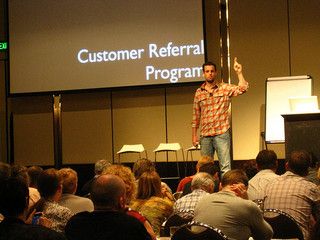

You don't need to believe you can become the next JFK or MLK but you do need to believe in your capacity to improve your skills.
People generally do better if they have agrowth mindset (you see yourself as a work in progress) vs. a fixed mindset (you believe your capacities are fixed).
Check - Do you have a growth mindset in terms of your public speaking skills?
2. Get confident at reducing phyiological overarousal.
You'll do a better job at public speaking if you're not in fight / flight / freeze mode while you're giving your talk.
Learn how to calm yourself physiologically by practicing slowing breathing, which will in turn reduce your heart rate.
When you notice yourself feeling stressed or anxious, practice slow breathing while your heart beat is increase and take long breath from your nose and leave it from mouth.
This is a great way to become confident in your ability to calm yourself physiologically.
Be aware that your heart rate is naturally faster when you're breathing in and slower when you're breathing out.
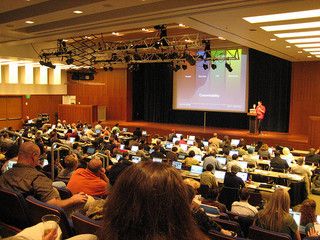
Source: http://www.flickr.com/photos/sheilaellen/2769434060 photopin CC
3. Practice looking at faces in the audience while you're talking.
People who are anxious tend to either avoid looking at the faces of people in the audience, or fixate on the faces of people who look bored.
Learn to look for signs of interest as well as signs of disinterest. Make eye contact and smile at individuals in the audience.
When someone smiles back, return your gaze to that person later in your talk.
4. Approach vs. Avoidance Goals.
Avoidance goals are things like "I want to avoid blushing" or "I want avoid feeling anxious while I'm talking."
Approach goals are things "I want to communicate my 3 key points clearly so that everyone in the audience leaves the talk understanding those points."
Approach goals are more useful than avoidance goals.
Identify what your approach goals are.
5. Video yourself.
People who are anxious often avoid objective performance feedback. If you believe you have the capacity to improve (see tip #1) objectively reviewing your performance will be less threatening (because you can correct any weaknesses.) Don't try to improve through just willing yourself to improve. Actually take steps that are likely to result in improvement such as videoing yourself practicing or working with a coach.
Making some short youtube videos (just a few minutes each) is a great way to practice and produce something useful from that practice.

No comments:
Post a Comment